In Rennes, several research teams have been testing protocols for a number of years that bring together residents, environmental sensors and artistic formats to generate knowledge about the local area. Often grouped under the label of participatory research, these approaches are based on the idea that combining methods and perspectives enriches field analysis.
Rennes’ academic landscape, with Université de Rennes 2, EHESP and CNRS, provides an institutional foundation for these experiments, while local associations handle some of the facilitation and networking.
Combining sensors and interviews: how mixed methods are changing urban research in Rennes
A study involving Université de Rennes, EHESP and CNRS combined particle sensor data with interviews and questionnaires completed by volunteers. The protocol did more than measure air quality: it compared what participants said they had changed in their habits with what the sensors actually recorded.
Combining the two types of data revealed discrepancies between reported changes and observable changes. Some volunteers said they had reduced their exposure to fine particles, but the measurements did not confirm this. This discrepancy does not invalidate participants’ accounts, but it does mean that any conclusions based solely on self-reported data need to be qualified.
For urban field research, this approach offers a useful principle: a single type of data is not enough to describe a practice. Sensors produce reliable numerical data series, while interviews capture the meaning residents attach to their practices. Either one on its own leaves blind spots. This feedback illustrates what SDN Rennes’ dynamic research documents about the diversification of local research protocols.
Participatory research in Rennes: who frames the questions, and who interprets the results?
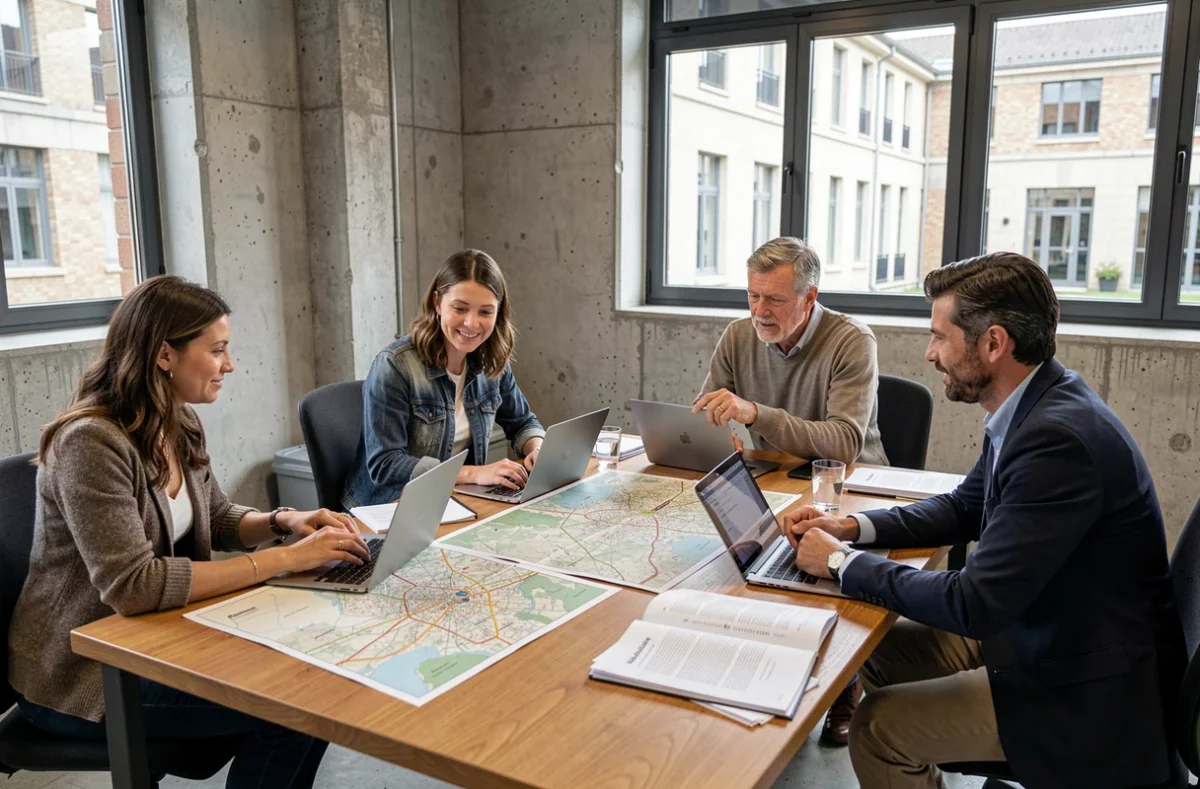
Involving residents in field research can take many different forms. In some projects, participants collect data (readings, measurements, observations) according to a protocol defined by researchers. In others, they help formulate hypotheses and discuss the results. This distinction is far from trivial.
Research conducted at Rennes 2 on the socio-ecological transition illustrates the second approach. One doctoral thesis drew on a research committee made up of residents from working-class neighborhoods. These residents did more than answer questions: they helped develop hypotheses and discussed the progress of the research. The aim was to start from residents’ knowledge and needs rather than treating them solely as research subjects.
This type of collaborative inquiry can bring to light everyday environmental practices that conventional approaches overlook. Daily acts of repair, reuse and sharing in working-class neighborhoods are not always captured by academic analytical frameworks. When residents formulate the questions themselves, these practices become research topics in their own right.
Documented limitations of co-construction
Participation does not automatically guarantee inclusive research. Studies on mixed methods point to several practical challenges:
- Bringing together different disciplinary frameworks (sociology, environmental science, urban planning) requires constant adjustments that slow the process
- Cooperation between research teams and resident groups requires an intermediary role, sometimes called a “third-party facilitator,” which cannot simply be improvised
- Adapting methods to the people involved takes time and facilitation skills that not all research labs have
- Reports often provide insufficient detail on who participates, at which stages, and how much influence they have on the analysis
A Cnam training course on participatory action research explicitly includes participatory design and workshop facilitation among the methods taught. It also highlights the challenge of reconciling researchers’ interests with those of stakeholders in the production of knowledge. Without this intermediary work, participation risks becoming little more than window dressing.
Art, science and sharing field research: hybrid formats tested in Rennes
Field research does not rely solely on strictly scientific protocols. In Rennes, collaborations between science, artistic creation and society have led to some unusual ways of sharing research findings.
A gathering focused on the art-science-society dynamic featured a documentary theater project connected to research by the Observatory of the Environment in Brittany. It also discussed a documentary about the restoration of the Sélune and residents’ attachment to the landscape. These formats do not replace the scientific paper, but they serve a purpose it cannot: sharing research in language accessible to those who contributed to it.
Documentary theater, for example, can stage contradictions or tensions that academic formats tend to smooth over. A resident whose words are incorporated into a play relates to the findings differently than someone who receives a summary report. How findings are shared partly determines the quality of future participation: a participant who does not understand what the research has produced will not come back.
Dynamic research and land management: a practical application in Rennes
Rennes Métropole faces the challenge of land-use efficiency, making diverse field approaches particularly relevant. The metropolitan area is seeking to reconcile economic development with limits on urban sprawl, which requires a detailed understanding of how existing business parks are actually used.
Conventional land-use study methods (cadastral inventories, surveys of businesses) produce useful but partial data. They describe land use without capturing informal dynamics: temporary storage, underused plots, and resource-sharing practices between neighboring businesses. Combining spatial data with local qualitative research could help map these invisible uses.
Participatory approaches to land use are less developed than in the environmental or social fields. Land-use data is often seen as technical and the preserve of urban planners. Involving local businesses in analyzing their own premises is a logical extension of methods tested elsewhere in Rennes, but there is not yet a consolidated body of experience on this specific topic.
Diverse field approaches in Rennes show that research becomes more relevant when it brings together multiple types of data and different groups of participants. The open question is less about the method than its institutionalization: these projects often run for the duration of a project or doctoral thesis, then stop for lack of recurring funding or stable institutional support.